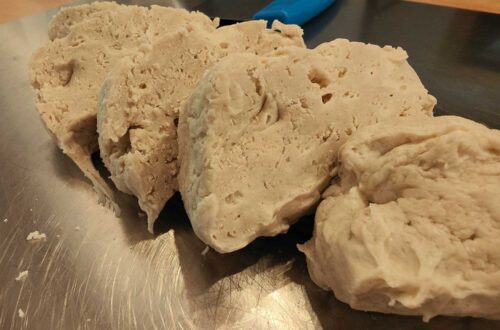

Biga: Why the window pane test can be a warning sign
In countless pizza videos on the subject of biga, the “perfect” window pane test leaves novice pizza makers in awe. “Only by passing the window pane test right at the end of your kneading process will your Biga pizza dough turn out perfectly,” is often the message from many influencers. Of course, a dough looks impressive when it can be stretched so beautifully and elastically right at the end of the kneading phase. But this doesn’t apply to every type of dough, and certainly not to Biga.
And so the keen home pizza maker kneads their Biga dough with high-gluten pizza flour (protein content over 13 per cent) during the final mixing until it passes the window pane test. They then proudly pull the pizza out of the oven. The pizza is rubbery rather than soft and delicately crisp. The big head-scratching begins…

Why a rubbery crust instead of a delicately crispy crust?
Whilst kneading, the amateur pizza chef made a technical error. A biga dough is not a direct dough. Structurally, biga works differently to a direct dough. A significant part of the dough’s structure is already formed during the preparation and fermentation of the biga starter. That is why, when making pizza dough with biga, you cannot simply apply the same rules as for a direct dough. With a direct dough, the gluten network must first develop during the kneading process. A biga, on the other hand, already has a well-developed gluten structure.
Our amateur pizza maker’s biga dough had therefore simply been over-kneaded. The gluten network was overdeveloped during the final mixing – kneaded ‘too perfectly’, so to speak. If a biga is over-kneaded during the final mixing, the dough structure can become too dense and tight. After baking, this can result in a rubbery texture rather than a tender, crisp mouthfeel.
The high-gluten pizza flour used initially masked this fault. As a result, the over-kneading wasn’t immediately noticeable, and the window test was, after all, apparently ‘successful’.
Why the window pane test is misleading in this case?
- The window test provides an indication of the development and elasticity of the gluten network. However, in the case of a Biga dough, a very well-formed window may also suggest that the gluten network has already developed too much by the time the dough is closed. This can result in a dough structure that is too tight and, after baking, a rubbery rather than delicately crisp crust.
- With Biga, therefore, a perfect window test is not automatically the goal – it can actually be a warning sign.
- The misconception: “A better window test = better pizza”. With Biga, an overdeveloped gluten network can lead to a rubbery rather than delicately crisp crust.


How do you knead Biga dough properly using a stand mixer?
The experienced Italian pizza chef finishes the dough by adding the remaining water and other ingredients – such as salt, extra flour if necessary, and diastatic malt – to the biga. Once all the ingredients have been mixed together after a few minutes, he looks out for the ‘dough moment’.
This is a brief moment when the dough is not yet fully developed, but has already achieved a smooth and cohesive structure. The ‘window test’ would still fail at this stage. And that is intentional. With biga, the aim is not to finish the dough with a perfect window test. Finishing the biga is about rehydrating, bringing the dough together and building its structure.
The pure kneading time for a biga dough until it reaches the ‘dough moment’ can be as little as 8–15 minutes, depending on the machine and the dough’s fermentation profile. Many inexperienced bakers, on the other hand, knead their dough for 25–30 minutes until the desired ‘window test’ is achieved.
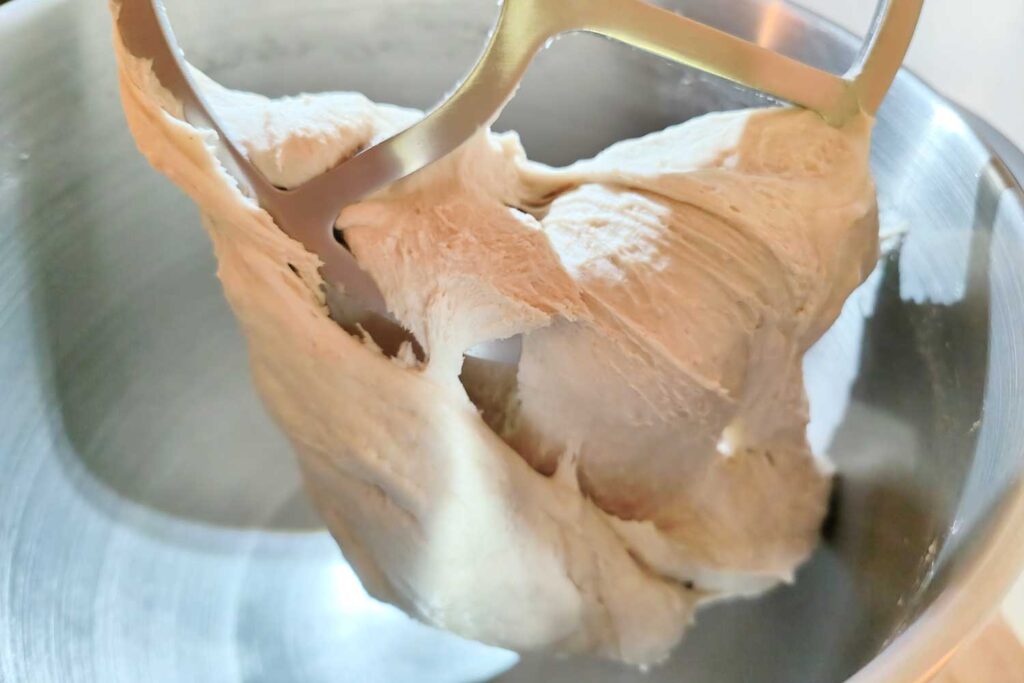
Why Biga dough appears ‘unfinished’
Once the ‘dough moment’ has been reached after 8–15 minutes, leave the dough to rest in the mixer for 15 minutes. After these 15 minutes, you will notice that the gluten structure has relaxed significantly. A window test on the worktop, as shown in my video on Instagram, is then possible and does not ‘harm’ the final result.
Note: Time trumps kneading time. The more the Biga dough is allowed to relax, the more the tension in the gluten structure can be released. This allows the dough to be shaped into a pizza with a delicately crisp yet soft crust.

Knut Sievers
Knut Sievers has been deeply involved in the art of making Pizza Napoletana for many years. As a self-taught pizza chef, his focus is on dough management, fermentation and, in particular, working with biga. On the Pizzaiolo Mallorca website, he shares his practical experience, experiments and insights into pizza dough and pizza.

Das könnte dich auch interessieren

Panuozzi – the allure of Naples