
Biga: Dough recipe for Pizza Napoletana Contemporanea
For me, the queen of pizza doughs is Biga. Biga is a preferment originating in Italy, which was originally used in bread-making. Pizza made with Biga is absolutely delicious and particularly easy to digest. The flavour of pizza dough made with Biga is much more pronounced than that of a direct dough or a pizza dough made with poolish, and is reminiscent of hearty bread. Here’s a Biga dough recipe I’ve developed myself, with a hydration of 70%. You’ll also find kneading instructions for your home stand mixer, so you can make the perfect pizza dough with as little kneading time as possible.
Ingredients for a 100% biga starter for 4 pizzas à 280 g
- 654 g pizza flour (choose a strong baking flour with a W value of 280–320 and a protein content of 13–14%)
- 294 g water (To determine the water temperature, use the “55 rule”: 55 – flour temperature – ambient temperature = water temperature.)
- 2 g dried yeast or 6 g fresh yeast
Mix everything by hand using the biga “No stress” method by Roberto Susta in a dough box or similar container until all the water has been absorbed and strands of dough have formed. There should be no loose flour remaining. Do not knead under any circumstances!
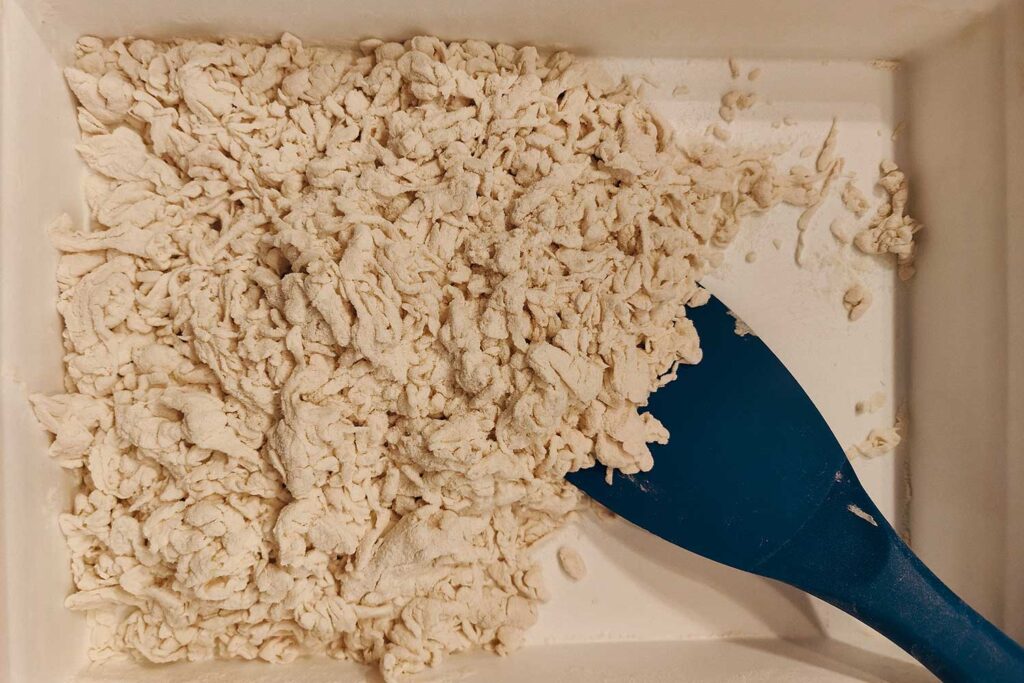
If you have a spiral mixer, you can also make the biga in it, provided it has a reverse function. The finished Biga should have a temperature of around 21 °C.
Fermentation for perfect flavour
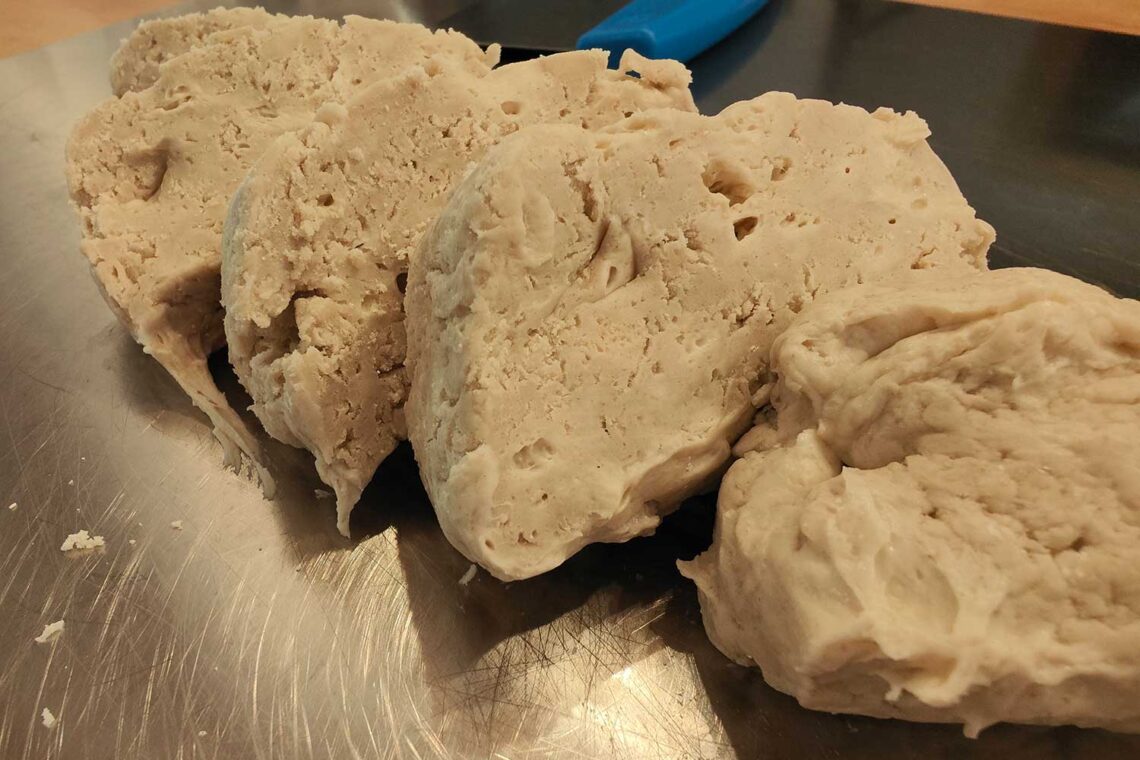
Place the Biga in a container and leave it to ferment for about 18 hours at 18 °C. In winter, the cellar works really well for this. Alternatively, place the Biga in the fridge for about 40 hours at a maximum temperature of 4 °C. After fermentation, your Biga will look like this; you can already see the very well-developed gluten structure.

To bring the dough together (by hand or in a kneading machine):
- The entire Biga
- 163 g water (ice-cold in summer, at room temperature in winter)
- 0.2 g of dried yeast or 0.6 g of fresh yeast (optional)
- 20 g salt
Pro tip: Kneading process in a standard kneading machine (Planetaria)
As most people have a standard household mixer, these instructions are based on using a kitchen machine with a planetary drive. Anyone who kneads pizza dough with Biga at home using a planetary mixer can easily make an unintended mistake that can compromise the stability and elasticity of the dough. This can have serious consequences for the final product, particularly with doughs made using 100% Biga.
Many people knead their dough for as long as it takes – often 25–30 minutes – until it passes the window pane test. However, with Biga, the window pane test should not be the aim of your kneading process. Read my specialist article on this subject: “Biga: Why the window test can be a warning sign”.
To help you achieve a similar result at home to that produced by a spiral mixer, I have put together detailed kneading instructions for you.
1. Knead the Biga (whole or crumbled) and a little water using the flat beater on speed 2/10 until the Biga wraps around the beater and forms strands. This takes about 4 minutes
2. Replace the flat beater with the hook and continue kneading for 4–5 minutes on speed 3/10, adding water a little at a time
3. Leave the dough to rest for 10 minutes to allow it to relax and the gluten network to develop
4. Add the salt, optional yeast and a little water. Continue kneading on speed 5/10 for 4–5 minutes, incorporating the remaining water a little at a time
5. Leave the dough to rest for 5 minutes
6. Knead very briefly (approx. 2 seconds on speed 10/10) until the dough wraps around the hook
7. Leave the dough to rest for 5 minutes
Steps 6 and 7 can be repeated up to three times. AIM: The dough should still feel firm in the hand test and should not yet be fully developed
8. After the final very brief kneading, skip step 7 and let the dough rest for 15-20 minutes instead
9. Perform 2–3 coil folds
10. Leave the dough to rest for 30 minutes
11. Perform 2–3 coil folds and shape a large dough ball to create tension
12. Bulk fermentation for 30-60 minutes, depending on the ambient temperature
13. Shape the dough balls
14. Final batch proofing as desired at room temperature or in the fridge
You can learn how to make a perfect biga dough in our Pizza courses on Mallorca.

Knut Sievers
Knut Sievers has been deeply involved in the art of making Pizza Napoletana for many years. As a self-taught pizza chef, his focus is on dough management, fermentation and, in particular, working with biga. On the Pizzaiolo Mallorca website, he shares his practical experience, experiments and insights into pizza dough and pizza.


Das könnte dich auch interessieren

Panuozzi – the allure of Naples
